November 12, 2008
 The Yes Men deliver another fake! BBC reports that the interventionist art/activist group distributed 1.2 million free copies of a fake New York Times edition in New York and Los Angeles. The headlines: Iraq War Ends. The date: July 4, 2009. Replacing the NYT’s venerable “All The News That’s Fit To Print”: All The News We Hope To Print.
70 years ago, Orson Welles’ radio broadcast “War of the Worlds” sparked mayhem because listeners mistook scripted fiction for real-time fact. Today, The Yes Men are taking this a step further by simply turning the dates forward.
Is this a fake NYTimes, as the BBC describes the action? Or is it prophetic? Is this a fake-real paper or a real-fake paper?
Certainly, my fingers are crossed that come July 4th, 2009, the NYTimes WILL, in fact, read: Iraq War Ends.
Ah… art. One small step for The Yes Men, a big leap for humankind. Nothing like putting something out into the universe I’m told.
 Leave a Comment » |
  activism, Art, Culture, News, Publishing, War | Tagged: contemporary art, fake New York Times, fake paper, intervention, the yes men |
  Permalink
 Posted by blixity
November 11, 2008
 For people in New York:
Orhan Pamuk speaks with Andreas Huyssen at Rennert Auditorium, Kraft Center at Columbia University on Tuesday, 11/11/08 – 6:15pm. The event is free. Seating is on a first come, first served basis.
Pamuk was awarded the Nobel Prize in Literature in 2006. The first Turkish citizen to win a Nobel, he accepted with this speech, in Turkish.
Leave a Comment » | Art, Culture, Events, Literature | Tagged: Literature, nobel prize, orhan pamuk, turkey | Permalink
Posted by blixity
November 10, 2008
In Ars Technica today: film studio MGM has partnered with video-sharing site YouTube to deliver full-length movies online. In the NYTimes: book publishers have signed a deal with e-giant Google (which also owns YouTube) to sell electronic versions of out-of-print, copyrighted works.
Both are obviously landmark deals that test possible unions between old and new media — parties that have been wary of each other, but whose business futures are hugely co-dependent.
Both also highlight a persistent (historically-pressing) need to redefine/rethink the role of the media creator (authors, musicians, visual artists, etc.). And her rights to her own produced, reproduced, and distributed works.
The 2007-8 Writers’ Strike is just one vivid illustration that the increasingly digital and transnational mediascape has far outgrown already-deficient intellectual property protections.
As more and more of old media creeps into the internet, the challenge will be to keep new media from morphing into the closed institutions and lopsided relationships it sought to tear down. The more things change the more they stay the same?
Let’s hope greater reach translates into greater financial support for media creators, not just middlemen. Information wants to be free! Yes, indeed. But artists need to be protected and compensated as well.
Note: Larry Lessig (Stanford University/Creative Commons) talked about copyrights and creative freedoms at this enlightening TedTalk back in March 2007.
Leave a Comment » | Culture, e-commerce, Fair Use, Internet Sales, Legal, Media, Publishing, Web | Tagged: copyright, digital media, google, internet, mgm, youtube | Permalink
Posted by blixity
November 7, 2008
 There’s been much excitement and speculation about how Obama will staff his Executive Office. With Joe Biden Jr. as VP (link to the Senate) and Rahm Emanuel as Chief of Staff (link to the House), the search is on for 15 new Cabinet members*: Secretaries of Agriculture, Commerce, Defense, Education, Energy, Health/Human Services, Homeland Security, Housing/Urban Dev’t, Interior, Labor, State, Transportation, Treasury, Veterans Affairs, and the Attorney General.
What missing? Secretary of Culture.
Call me biased, but pretty much all the most powerful nations in the world have one. There are Ministers or Secretaries of Culture in France, England, China, India, Russia, Brazil, Spain, Italy. And so on and so on.
It’s the 21st Century: America needs one.
Obama’s victorious campaign itself proves that images, words, beliefs, attitudes, narratives, and aspirations can bind us together, powerfully, as a nation (and tear us apart — as Dubya’s violent legacy proves).
Culture — the ideas, practices, and ideals people share — is a dynamic and critical apparatus of any nation-state. Mightier than steel, as Obama wisely put in his acceptance speech. More primal than religion, if I may add.
In these dark, fractious days, the strength of American Culture/s (or at least, the belief in it) just might be that magical something, that je ne sais quoi, that pulls us through to a new and better era.
So, I’m putting this out into the blogosphere: Secretary of Culture, Please!
(Cultural Council would be cool too.)
*For posterity, here’s a pdf of Dubya’s Cabinet.
Leave a Comment » | Culture, Elections 2008, News, Politics, presidential elections, society | Tagged: barack obama, cabinet, Culture, executive branch, obama, Politics | Permalink
Posted by blixity
November 6, 2008

Amazon.com had this ad up today. It’s funny enough on its own. Then I thought, there’s an even funnier role reversal here. Shouldn’t they be offering a free McCain doll with purchase of an Obama doll? I’m assuming that popular demand for the winner’s doll would be greater than that of the loser’s. I mean, generally, who pays for the loser’s memorabilia? (That’s akin to buying holiday decorations on the day after. What’s the point, right?)
Maybe Obama’s popularity is so strong right now that a free Obama toy WILL actually get someone to shell out the big bucks for a McCain doll?
Maybe there are some microtrend market studies out there that say more McCain supporters happen to be toy collectors as well. Or maybe more toy collectors happen to support McCain. Who knows.
Get yours while supplies last!
Leave a Comment » | Advertising, Culture, e-commerce, Life, Toys | Tagged: barack obama, dolls, Elections 2008, john mccain, mccain, obama, political toys, Toys | Permalink
Posted by blixity
November 6, 2008
The sun seemed to shine a whole lot brighter yesterday morning after America voted to get Barack Obama into the White House by an overwhelming margin. The NYTimes headlined: “Racial Barrier Falls as Voters Embrace Call for Change”. Just as Germany tore down the Berlin Wall, we cast our votes to overcome this conveniently-exclusionary thing called Race. We are Making History.
So, what the hell were the states of California, Florida, and Arizona thinking when they simultaneously voted to BAN same-sex marriages? Let’s stop discrimination but only with regards to Race? Hey, go right ahead with those barriers against same-sex couples? Yes, we are Making History indeed. Who ordered the Rain on Our Parade.
According to the NYTimes yesterday afternoon: In California, 52% voted for a ban on same-sex marriages (already deemed legal by the California Supreme Court back in May). Homophobes in Florida and Arizona won by even bigger margins. Arkansas passed a measure that bars gay men and lesbians from adopting children.
THIRTY states have now passed bans on same-sex marriage. Only Massachusetts and Connecticut consider same-sex marriages legal. Rhode Island and New York recognize marriages performed elsewhere.
Why do religious fundamentalists consider marriages between same-sex partners such a profound and urgent threat to the traditional family unit headed by a male/female partnership? Aren’t the cultural trends towards divorce and single-parenthood even bigger (more logical) threats? And speaking of race, why do so many black and Latino votes support the bans on same-sex marriages?
It seems to me: If you want to fix the family, fix the FAMILY. Don’t blame other people. Don’t exclude alternate lifestyles. Really, Stop The Hate Now.
These bans are crimes against humanity. As Obama’s win unleashes a “Flood of Hope” worldwide, we need to direct some of that energy against the bigots that hide behind the dark cloud of religious fundamentalism.
Yes We Can. Let the Sunshine In.
1 Comment | Diversity, Gay Lesbian Queer, Human Rights, Life, News, Politics, Religion, society | Tagged: arizona, arkansas, california, florida, gay, lesbian, proposition 8, right to marry, same-sex marriage | Permalink
Posted by blixity
November 5, 2008
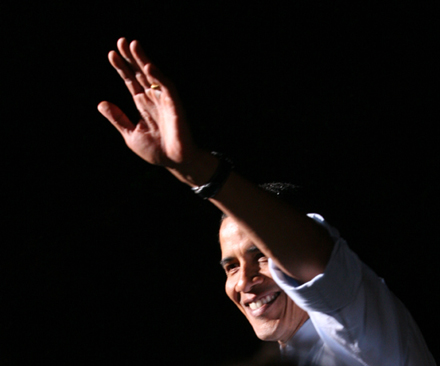
“This is our moment. This is our time.”
Listen. Yes We Can.
Leave a Comment » | Politics | Permalink
Posted by blixity
November 4, 2008
 As Americans head to the voting polls today to decide who will be the 44th President of the United States, four million American citizens who are residents of Puerto Rico will be barred from casting their ballots.
A Spanish colony from 1493 to 1897, Puerto Rico was ceded to the U.S. under the Treaty of Paris in December 1898, putting an end to the Spanish-American War. It marked the end of the Spanish Empire in the Americas and signaled the rise of U.S. colonialism.
In 1917, Puerto Ricans were granted U.S. citizenship and in 1947, the right to democratically elect their own governor (previously an appointed post). In 1952, they drafted their own constitution which was ratified by Congress and approved by President Truman.
Today, Puerto Rico is officially an Estado Libre Asociado (which translates into “Free Associated State”) or Commonwealth: a self-governing territory — with its own executive, legislative, and judicial branches — that is subject to U.S. jurisdiction and sovereignty. It belongs to the U.S., but is not part of the U.S. It has limited (non-voting) representation in Congress. Its head of state is the President of the United States — who it can nominate in party primaries (as we saw on June 1st), but NOT vote for in presidential elections.
So, today Americans vote for President. And Puerto Ricans vote for Governor: not-quite-equal-citizens in a not-quite-independent, not-quite-common land for almost a century.
It’s definitely time for change. We’ve waited far too long. Here’s hoping today is the day change makes history. Vote OBAMA.
6 Comments | Constitution, Elections 2008, Events, News, Politics, society | Tagged: Elections 2008, neocolonialism, postcolonialism, puerto rico, voting | Permalink
Posted by blixity
October 30, 2008
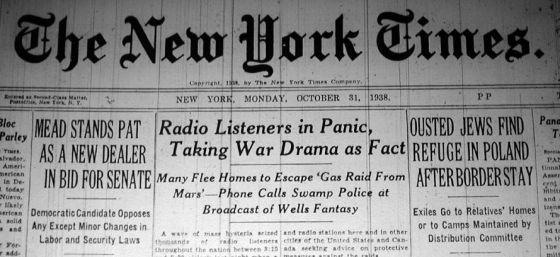
On October 30, 1938, Orson Welles and the Mercury Theater on the Air broadcast a radio play based on H. G. Wells’ science-fictional work, “The War of the Worlds“. The hyperrealistic play about an invasion of Earth by Martians created mass hysteria among thousands of radio listeners who had tuned into WABC and CBS’ radio network from 8 to 9 that evening.
The next day, the New York Times reported on the historic event:

Despite prior announcements and an introduction about the play’s imaginary content, thousands of listeners believed an alien invasion had indeed begun. Police stations and newspapers nationwide, but particularly in New York and New Jersey (non-fictional site of the fictional alien attacks), were swamped with frantic calls for help and rescue.
After the event, CBS, Mercury Theater, and Welles expressed their profound regrets at having stirred up so much fear, anger, and panic. Ironically, Welles disclosed that he had hesitated about presenting the play because he thought that “perhaps people might be bored or annoyed at hearing a tale so improbable”.
70 years ago today, the great Orson Welles tapped into the power of mass media and the lure of dramatic narrative — and unexpectedly, revealed how much we want to believe.
Leave a Comment » | Art, Culture, Entertainment, Media, society | Tagged: famous radio broadcasts, h.g. wells, science fiction, war of the worlds | Permalink
Posted by blixity
October 29, 2008
Today, a French court rejected President Nicolas Sarkozy’s demand for a ban on a Sarkozy voodoo doll released by French company K&B earlier this month. According to BBC, the Paris judge ruled that the doll was “within the authorized limits of free expression and the right to humour”.
 The voodoo kit includes a manual, a doll emblazoned with some of the president’s more memorable quotes (including “Get Lost You Pathetic Asshole” and “Work More To Earn More”), and pins for users to stick into the doll.
Sarkozy’s lawyer had argued that like any French person, Sarkozy owned the right to his own image, which was violated by the sale of the doll. According to the Guardian, the highly litigious president has been ridiculed by his critics for launching the legal action — his sixth lawsuit since his election. The doll has become a must-have.
Earlier this year, Sarkozy and wife Carla Bruni won a case against Ryanair for using their image in a Paris newspaper ad without permission. Sarkozy has also launched a legal case against another company that produces novelty T-shirts bearing his name and a target sign, saying “Sarkozy Tolerance Zero”.
Whatever happened to Liberté, Égalité, Fraternité ?
Photo: Franck Fife/AFP/Getty images
Leave a Comment » | Culture, Entertainment, News, Politics, Public-Private, society | Tagged: carla bruni, censorship, french courts, nicolas sarkozy, sarkozy voodoo doll | Permalink
Posted by blixity
October 23, 2008
 In Time Magazine’s October 27 issue, “Verbatim” (its regular page of quick quotations) includes this statement from Sheriff Thomas J. Dart of Cook County, Illinois:
We’re just not going to evict innocent tenants. It stops today.
According to Time, Dart said this upon “suspending foreclosure evictions in the Chicago area because renters were not being properly notified about their landlords’ financial problems.”
Without knowing much else about Dart, his stand struck me as so profoundly and simply human. Yes, let’s just stop kicking people out of their homes. It could be as simple as that. We’ve got to start somewhere.
My Google search led to a CNN article about the sheriff. Apparently, he made the statement on October 8 to protect innocent tenants who are “victimized by an uncaring, reckless system.” On October 16, he announced he would resume evictions but these would be based on specific conditions (see CNN report). Also, that he would hire a social worker to help evictees find alternative housing.
That’s heroic. Yes, one person saying “no more” CAN make a difference.
Of course, CNN also reports that the Illinois Bankers Association is critical of Dart’s actions, saying he was “elected to uphold the law and to fulfill the legal duties of his office, which include serving eviction notices.” Now THAT’s a crime.
blixity to the Illinois Bankers Association: Shut The Fuck Up.
Dart is one public official who seems to be looking out for his public. A blixity tip of the hat to a GOOD MAN in deed.
Leave a Comment » | activism, Crime, Culture, Human Rights, Legal, Life, Politics, protest, real estate, Recession, society | Tagged: cook county, evictions, foreclosures, illinois bankers association, thomas dart | Permalink
Posted by blixity
October 20, 2008
 “Mobile Art”, a slick UFO-like exhibition space designed by architect Zaha Hadid and commissioned by Karl Lagerfeld of Chanel, has arrived at Central Park’s Rumsey Playfield (off Fifth Avenue and 69th Street). The traveling container for about 20 Chanel-inspired projects (very kindly misbilled as contemporary art installations — don’t be fooled: it’s corporate branding) by a rotating list of international producers will be open to the public from October 20 to November 9.
The promotional-spectacle-disguised-as-art container is on a two-year worldwide tour. Launched in Hong Kong in February 2008, it traveled to Tokyo before arriving in New York. In November, it continues onto London, then Moscow, and finally Paris in 2010. (These stops probably represent the fashion house’s most lucrative markets, yes?)
Adrian Benepe, NY’s Parks & Recreation Commissioner, is ever-eager to further the corporate takeover of public space, aka public-private partnerships:
Our partnership with Chanel continues the great tradition of bringing world class cultural offerings to New York City’s parks… Zaha Hadid’s traveling pavilion will place a futuristic work of architecture and outstanding works of contemporary art in an historic setting in the heart of Central Park. The contrast will be fantastic, melding the vision of one of the world’s most important fashion houses with the beauty of one of the world’s most significant works of landscape design.
Bruno Pavlovsky, Chanel’s Fashion President, is ever-eager to equate the company’s products with art:
Mobile Art was conceived as a project that examines the relationship between contemporary art, fashion and architecture. The project pushes the boundaries of the Chanel aesthetic by joining these mediums and creating an innovative artistic experience. As envisioned by Karl Lagerfeld, the project explores the role fashion plays in the everyday life of women through symbolic evocations of the Chanel quilted handbag.
ACK. In the midst of today’s economy, this recalls Marie-Antoinette’s response when she was told that the French had no bread to eat: “Let Them Eat Cake!”
Leave a Comment » | Advertising, Architecture, Art, Branding, Culture, Design, Entertainment, Fashion, Public-Private, society | Tagged: Architecture, Art, Branding, corporate promotions, Fashion, public art, public parks, public space | Permalink
Posted by blixity
October 19, 2008
 Lucian Freud’s unfinished portrait (1956-7) of his friend Francis Bacon had many in the global art market holding their breaths. Up for auction tonight at Christie’s in London, the painting was expected to fetch £7 million. Bloomberg reports that it sold for much less: £5.4 million.
After lower-than-expected contemporary art sales at Sotheby’s, Frieze, and now Christie’s, dealers consider the Freud sale to be a sign of a stalling global market and a deepening financial crisis.
The Independent on Sunday reports great apprehension:
The global art market is all but dead already, except for buyers of ‘trophy art’ whose fortunes have previously seemed unassailable. If they stop bidding, prices will plummet.
Freud’s portrait was considered a harbinger for super-rich spending. The fact that it sold for less than expected (although still above the presale low estimate of £5 million) indicates that even trophy buyers are cutting back.
Fasten your seatbelts. Turbulence ahead.
Leave a Comment » | Art, Art Market, Culture, Economy, News, Recession | Tagged: Art Market, contemporary art, economic downtown, francis bacon, london auctions, lucian freud, Recession | Permalink
Posted by blixity
October 19, 2008

NYT’s top cultural chronicler Bill Cunningham ran the lead photo above for his “Evening Hours” page this Sunday. From left: Cardinal Edward M. Egan, Alfred E. Smith IV (great grandson of Smith), Nan Smith, and Senator Barack Obama at the Alfred E. Smith Memorial Foundation dinner held on October 16th at the Waldorf-Astoria in New York City.
The dinner reportedly raised $4 million for underprivileged children. Which is (undeniably) well and good. It also brought together — in royal white tie — the city’s (arguably, the nation’s) political, cultural, and media elite: both presidential hopefuls, both state senators, the city’s 3rd-term-seeking mayor, a Catholic archbishop, news anchors, and so on and so forth.
Power. With a capital-P. I can’t help but think how much of our futures were shaped that night.
No surprise to anyone that politicians must pal around with the ruling dynasties of wealth and religion in order to get work done. But I am curious about whether and how Obama’s promise of change will weather these dominant regimes with which he is ostensibly at odds.
Certainly, there is no choice. Obama MUST/WILL become the next American president. There is much at stake. One hopes his presidency radically alters photographs such as this.
Leave a Comment » | Culture, Elections 2008, Media, News, Politics, presidential elections, Religion, society, Wealth | Tagged: alfred e. smith, barack obama, new york city, Politics, power, presidents, Wealth | Permalink
Posted by blixity
October 10, 2008

Left: Putin executing a martial arts move.
Right: Bush executing an “oops” move.
Leave a Comment » | Culture, Politics, society | Tagged: george w. bush, president, russia, united states, vladimir putin | Permalink
Posted by blixity
 The Yes Men deliver another fake! BBC reports that the interventionist art/activist group distributed 1.2 million free copies of a fake New York Times edition in New York and Los Angeles. The headlines: Iraq War Ends. The date: July 4, 2009. Replacing the NYT’s venerable “All The News That’s Fit To Print”: All The News We Hope To Print.




 blixity